College Home Security:
Careless Roommates
Taking Control
Many women worry about this exact scenario – and here's how you can take control. You will be more secure and feel more secure by following the guidance on this page. Knowledge is power.
It's a Group Effort
No group is any safer than its most careless member – and imposing sensible habits on careless people is usually a difficult task. It’s okay to be the ‘strict’ roommate when your life is on the line.
Carefully choose roommates. And remember that colleges do not screen students for criminal records.
Search online for 'Roommate Boundary Scripts' that cover your concerns, such as locking doors, guest policies, and shared security responsibilities, etc. to help enforce safe habits even with careless roommates.
BEFORE Renting Your Off-Campus Property
Call the local police department and ask for the community officer of that neighborhood to evaluate the crime rate.
Parties = Lack of Security
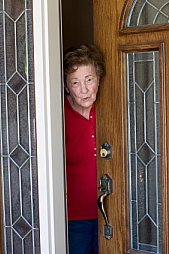
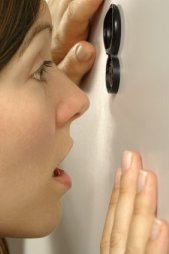
Parties are very vulnerable to intruders - the doors are usually unlocked - especially if it's an ongoing party with people coming and going at all hours. Or, if there's a knock at the (locked) door, someone usually opens it without first checking to see who's there. None are so blind as those who refuse to see the risks of careless security - until crime strikes. See the Walk-In and Push-In invasion links listed below.
A Safe Room (or Closet)
It's vital to fortify your bedroom (or maybe your closet) to serve as a refuge if ever you feel endangered - or just to spend time there, sleeping or studying while fully secure. See Safe Room.
Basic Rules for College Security: Home Defense
► Keep your doors, windows, and exterior doors locked at all times.
► If you lose a key, change the lock as soon as possible (or have the lock re-keyed by a locksmith). Any key lent out can be copied (whether or not it’s a “restricted” key).
► When alone, avoid isolated stairways, basements, or laundry rooms.
► Make sure you know who is trying to enter your building before you let them in. You're not obligated to be graciously kind.
► And remember that females commit ~20% of violent crimes (per the FBI). Some may seem friendly (at first), commit crimes alone, or in groups, or help male partners. So evaluate ALL strangers by their behavior and red flags.
► Report suspicious people or activity immediately to the police.
► If you move into a house, first have the locks re-keyed by a locksmith. Former tenants - and any of their friends - might have a copy of your key!
Pages related to Home Security - College
I've classified all home intrusions into five types to help you truly understand home security. To add to the familiar police terms of Break-In, Walk-In, and Push-In, I’ve created two new categories: Scam-In and Mug-In::
► Break-In: most homes are easy to invade. Learn what burglars hunt for.
► Walk-In: half of all home intrusions are through unlocked doors!
► Push-In: blindly opening the door if someone knocks. It's better to use an inexpensive, portable, wireless intercom.
► Scam-In: believing a stranger's clever scam and opening your door, even an inch - see Push-In above.
► Mug-In: how to avoid being ambushed outside your home and forced in.
Also see:
► Cracks in Security: subtle variations of Break-In, Walk-In, Push-In, Scam-In, and Mug-In home invasions.
And make sure you see College Security FAQ.
You now have the knowledge to make your college home far safer. Start today with one easy step: lock doors/windows, set roommate boundaries, and check your neighborhood with local police. You're not paranoid—you're smart and in control. Each choice protects you and your roommates.
NOTICE: This non-profit website is for informational purposes only and is drawn from the bibliography and USDOJ. Use the information at your own risk. See disclaimers.
Crime-Safety-Security > Home Security Overview > College Home Defense