Security Products:
HOUSE ALARM SYSTEMS
for Home Defense
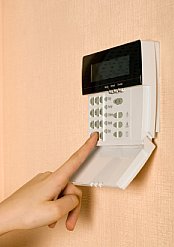
Our ancestors would've been in awe of the superb space-age security products we have available to protect our homes.
Homer Garza, Sr. of Modesto CA awoke to a nightmare when his security alarm shrieked just before he heard his front door crash open. His feet had barely hit the floor when two masked men were in his face with flashlights and guns and demanding he turn off the ear-piercing alarm. He obeyed.The alarm company agents began phoning his home. He couldn’t answer with his hands tied. When nobody answers, the company notifies police.
Even if Garza had answered, he’d simply give a false code word and the company would notify police. The phone kept ringing unanswered and started to spook the invaders. They fled.
Always keep your alarm system activated - especially when you're at home. Though it's sometimes inconvenient, it'll soon become an unconscious habit - like always wearing a seatbelt when driving.
BASICS OF HOUSE ALARM SYSTEMS

The best home security systems include:
• Contact Sensors for exterior doors and ground-floor windows,
• Outdoor Motion Sensor,
• Indoor Sounder (alarm), and
• Master Control Unit - connecting all the above together as an integrated house alarm system.
I highly recommend additional options:
• Monitored Smoke Detectors give an early warning of fire – even when you're not at home.
• Outdoor Sounder (alarm) alerts your neighbors to help you.
• Surveillance Cameras with TV Monitor (and motion-activated recorder) let you see without being seen (and record activity when you're not at home).
• Panic Buttons are excellent for any emergency – crime,
fire, or medical. A pocket remote-control unit while you’re anywhere in
or around your home can summon emergency help and/or help scare off a
criminal.
Yard Signs & Window Decals
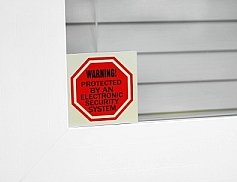
Yard Signs and Window Signs to deter burglars. 76 percent of burglars, even though they know many signs are phony, will move on to an easier target just in case. But it's risky to bluff with your security - real home burglar alarms are a better idea. Seclusion greatly benefits a burglar.
Secluded homes should use the best home security systems as well as all the products listed in the menu below.
Burglar Alarm Equipment SENSORS
Sensors that activate house alarm systems may include the following:
• Magnetic Contacts, the most common components of alarm systems, are located where doors, windows, and drawers meet their frames. Opening the door breaks the contact and activates an alarm.
• Plunger Contacts, like magnetic contacts, are located where doors, windows and drawers meet their frames. Opening the door breaks the contact and activates an alarm. (Plunger contacts, for example, are used on car and refrigerator doors to control the interior light.)
• Foiling, the metallic ribbon you’ve often seen snaking around the edges of a store’s window glass, activates an alarm if the glass and foiling are broken. Its easy visibility might deter burglars.
• Photoelectric or Infrared Beams detect anyone entering a given space and activate an alarm. However, pets, mice, dust, or wind-blown leaves may cause false alarms. (These beams, for example, are used to control elevator doors closing safely.)
• Motion Detectors use ultrasonic waves to detect anyone entering a given space and activate an alarm. However, pets, mice, or wind-blown leaves may cause false alarms.
• Vibration Detectors on doors, walls, and windows activate an alarm when disturbed. However, heavy footsteps, thunder, and loud cars passing by may cause false alarms.
• Passive InfraRed (or PIR) Detectors sense infrared heat (body heat) within an indoor area and activate an alarm. However, pets and mice may cause false alarms.
Additional products can be added to the basics above to cover all aspects of your security. See Simple Home Electronics to fit your unique needs.
You should supplement house alarm systems with overlapping layers of protection to provide superior burglary prevention.
Of course,
NO security products are guaranteed to prevent any crime - but might serve you well if combined with the guidance in Home Security Overview and Outdoor Safety Overview.
Crime-Safety-Security > Security Products Overview > House Alarm Systems