Outdoor Safety Tips for Women:
SPOTTING DANGER

Outdoor safety includes spotting danger before it's too late.
He parked his car at the curb of an Oakland CA street as if it were disabled. When his first victim walked past, he punched her and shoved her into the back seat of his car. A male witness intervened, delaying the kidnapper just long enough for the victim to escape through a rear window. The kidnapper fled in his car.His second victim was waiting at a bus stop when he
walked up and put a gun to her chest. He put his arm around her as if he
knew her and began to “casually” guide her toward his car parked around
the corner. She didn’t cooperate. She first dropped to the ground and
kicked at the suspect, and finally ran away. The kidnapper returned to
his car and fled. (See the stats below.)
See Defensive-Ground-Kicks at Fighting Options - Strategies and especially, Child Safety Tips: Kidnapping Escape for kids and teens and adults.
Signs for Spotting Danger
• Any behavior changes as he comes near.
• A hidden, motionless hand is unnatural when he walks.
• Matches your moves: he stops and goes when you do.
• Challenges you: “What did you say?” “What are you looking at?”
• “Sandwiches” you: two people approaching from different directions.
Watch for distant people as they come near. Many criminals "telegraph" their intentions, such as crossing the street to intercept you, and quickly looking around for any witnesses. Watch for groups that split up to encircle you. Run toward safety while yelling for the police.
So advises Kelly McCann, former U.S. Marine Corps Special Forces officer now of Crucible Security in Virginia.
HOW HE REACHES FOR A WEAPON
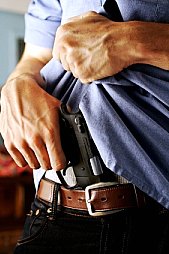
When a criminal reaches for a gun, it usually looks like he's reaching for his wallet with one hand – either from his back pants pocket, rear waistband, or the inside front of his jacket. If the gun is tucked into his front waistband, he'll probably use two hands – one to lift his loose shirt that's been hiding the gun, the other to grab the gun. Either way, by the time he gets the gun into position to fire, you can be already running away in full stride.
Beyond extremely close range (0-3 feet is "point-blank range" and
3-9 feet is "close range"), handguns are very difficult to shoot
accurately (unlike absurd TV shows and Hollywood movies). According to Sanford Strong, retired San Diego police SWAT
team instructor and author of “Strong on Defense,” police officers miss
with 75 percent of close-range shots while criminals miss with 96 percent of close-range shots. And a moving target is more difficult to hit.
Besides, according to J.J. Bittenbinder, Chicago police detective and author of “Tough Target,” US DOJ stats show there’s only a 12 percent chance that a criminal will call attention to himself by firing a gun in a populated area (at any range) and only a 3 percent chance of hitting you fatally. Finally, think about it - if an attempted kidnapper is willing to kill you on the spot, he's likely to do worse as he kills you more slowly in a secluded spot of his choice.
However, knives are more easily hidden, more quickly drawn, and have no “loudness deterrent” because they are silent. Still, throw down your wallet as you run away. For complete details, see Kidnapping and Kidnap Survival.
Also see Self Defence: Weapon Disarm | video 1m29s
Especially see Can You REALLY Disarm a Gunman? | video 11m02s | 8:49 A surprise ‘gun-grab’ is pure luck – too unreliable. It’s better to first verbally distract him (as in Victim’s Options - Outsmarting and Verbal Self-Defense | 9:17 “Cognitive Friction” is a verbal distraction to precede your ‘gun-grab.’ But, still, your odds are NOT good. | 10:32 Summary: It IS possible to disarm him but NOT probable…. |
Much the same goes for “What if he has a baseball bat, club, axe, hammer, screwdriver, taser, etc.?” Again, first verbally distract him before launching your surprise “Stun and Run” combination of #1 Eye Whips, #2 Throat Punch, #3 Knee/Groin, #4 Heel Stomp his foot, OR Clinch Attack/Bite Off his nose, or lips, or cheek, or ear. These are banned by the MMA and UFC tournaments because they’re so severe – which is exactly what an innocent victim needs to escape from a violent criminal. Also, Grip/Rip a rapist’s genitalia (as in Rape Escape Options – Ultimate It’s better to know this and not need it – than to need it and not know it.
See Eye Whips and Clinch Attack on Fighting Options – Self Defense Techniques. Even if you’re super busy, you can practice the above Eye, Throat, Groin, Foot combination for ONE minute every day so it’ll become reflexive.
HOW TO HELP SOLVE A CRIME
If you’re a victim or an eyewitness:
• During the crime, notice clothing and hair, though they can be changed. Especially notice things a criminal can’t change, such his lips, teeth, eyes, nose, and walk.
• Afterward, write down a description to fix your thoughts before you talk to anyone.
• Insist on open-ended questions from police interviewers. Don’t allow visual aids like photos or logs of facial components if you’re questioned for a composite sketch.
• Tape-record your police interviews to ensure that you’re not misquoted. You have the right to obtain the written police reports to compare with your tape.
See After Being Attacked – Immediately Call the Police in Victims Options - Fighting.
SPOTTING A TERRORIST
Warning signs if terrorists target a public place:
• Someone returns often.
• Photographing or note-taking.
• Pumping you for information.
• Leaving a possible bomb – any package or vehicle – near a possible target, such as a main building or crowds of people.
If you see something suspicious:
• Quickly move away.
• Remember descriptions – especially a car’s license plate numbers.
• Notify the police IMMEDIATELY!
Enhancing Your Outdoor Safety Options
Deter a predator by carrying a Personal Security Alarm (screamer or noisemaker) & Pepper Spray in plain sight. Those pages show you how to most effectively use them when spotting danger.
Crime-Safety-Security > Outdoor Safety Overview > Spotting Danger