Criminal Minds:
Mind Games
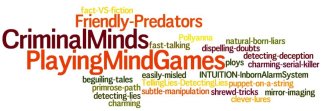
How the criminal minds of Friendly Predators trick you with mind games - and how you can avoid being fooled.
The charming serial killer Edmund Kemper used subtle manipulation to lure coeds hitchhiking near the University of California in the 1970's. He would pull over and ask the girl where she was going. Then he’d look uncertainly at his watch – as though deciding if he had time to take her there. This made him seem nonchalant about getting her into his car – and eased any anxiety the girl might have had.INSIGHTS INTO MIND GAMES
The endless variety of the shrewd tricks of criminals is shown in the many anecdotes throughout this website. Friendly predators often use variations of high-pressure sales tactics. They control their body language, tone-of-voice, and verbal phrasing in order to appear “low-pressure” while they try to control you like a puppet on a string.
Research shows that most people think they are good at detecting lies, when in fact, most are not. Dr. Paul Ekman of the University of California at San Francisco, widely considered the world's foremost authority on deception, found that supposed experts – FBI agents, police detectives, judges, prosecutors, lawyers, polygraphers, psychotherapists – are no better at detecting deception (especially of criminal minds) than by chance, like everyone else - the same as flipping a coin: a 50/50 chance of heads or tails. In “Telling Lies,” Dr. Ekman wrote:
"Most people pay attention to the least trustworthy sources – words and facial expressions – thus are easily misled."Psychopaths and 'natural-born liars' are far too slippery to catch in a lie. Superb actors, they can turn on and off sobbing, tears, compassion, joy - any emotion or tall tale - and convince you of their sincerity while manipulating you like a puppet-master.
Since there’s no reliable method of detecting lies, it’s better to simply watch the overall intent of his conversation. Is he trying to get close to you or get you alone?
Robert Greene, author of “The 48 Laws of Power,” described how predators fool victims by using selective honesty and generosity, playing dumb, controlling the options, and getting victims to “play with the cards he deals.” And the old “carrot and the stick” strategy is pulling with one hand while pushing with the other – shaming you while also offering you relief from that shame – as described below in Typecasting.
HOW THEY PLAY MIND GAMES
Renowned security expert Gavin de Becker, author of “The Gift of Fear,”
outlined a variety of ploys used by friendly
predators to gain the prey’s trust. They’re subtly designed to fool you
into ignoring your Intuition – your inborn alarm system that’s trying to warn you of something amiss. To paraphrase them:
► Forced Teaming: Slickly creating a “we” or “us” team from what is really a you vs him situation. For instance, he’ll flatten a tire on your parked car, hide nearby until you arrive, then just happen to come to your “rescue” saying, “How can we solve this problem?”
► Charm: One of a con man’s greatest assets is really nothing but a phony, cheap ploy – a tool to control you and suck you into his trap. Afterwards, victims often say, “But he seemed so nice.” (At first….)
► Too Many Details: Talking fast and adding unnecessary details to hide or reinforce a weak story or lure.
► Ignoring Your Objections: He just keeps talking, regardless of what you say, refusing to hear your “No.” A polite target eventually just gives in and submits to the lure. A savvy target doesn’t.
► Typecasting: He’ll imply that you’re too snobbish, bigoted, uninformed, or proud to accept his proposal. He hopes you’ll become anxious to prove him wrong by swallowing his lure.
► Loan-Sharking: Offering you help, then expecting you to “owe” him and return the favor by falling into his trap.
► Unsolicited Promise: To sway you, he’ll try to ease your doubts by “promising” something (as though that’s an ironclad guarantee). Such as, “Just let me in for one minute. That’s all, one minute. I promise.”
Another ploy is to insert elements of truth into a scam. Criminals interweave fact and fiction into beguiling tales.
INTUITION IS A SURVIVAL TRAIT
You’ve been civilized to get along with others. When someone wants a rather small favor, your first impulse is to be nice, to help. Friendly Predators use a Pollyanna’s goodwill to trap her.
Dr. Anna Salter, author of "Predators,” has interviewed many violent felons in prisons. She felt like a Grinch when briefing a Pollyanna psychotherapist colleague of hers about criminal minds: “You’d be a sucker in a prison. They’d tell you what you want to hear and what you want to be true. You'll twist reality to create a kinder world than really exists.”
American CIA intelligence analysts guard against the pitfall of mirror imaging: the projection of our society's values, beliefs, and behavior onto enemies and rivals. As well, normal, healthy people project their own values onto criminal minds, thinking, “Oh, I don’t need to worry. Nobody wants to harm me,” without realizing how different – how demented – are the minds of criminals.
Sex offenders are often like polar bears at the zoo. They look calm and gentle, but if you fall into their enclosure, they will kill you. If you believe what a sex offender tells you, you will get conned every single time.We tend to see and hear what we want to see and hear. Unless something jolts us, we tend to stay on track – ignoring our intuition – and reinforce, rather than recalibrate, our expectations. Unless past experience taught us to be wary, we're socially conditioned to hope for the best while trusting a Friendly Predator.
The best way to navigate our ever-deceptive world is with an ever-skeptical attitude guided by your Intuition. LISTEN TO IT!
PERSONAL SECURITY DEVICES
Carry a Personal Security Alarm (screamer or noisemaker) & Pepper Spray in plain sight. Those pages tell you how to use them most effectively.
Crime-Safety-Security > Criminal Minds Overview > Mind Games